Owner Managed Businesses
Alanah Lenten
June 2026
At the UK Fast Growth Summit, Professor Dylan Jones-Evans OBE shared with us his insights from the longest-running study of high-growth businesses in the UK.
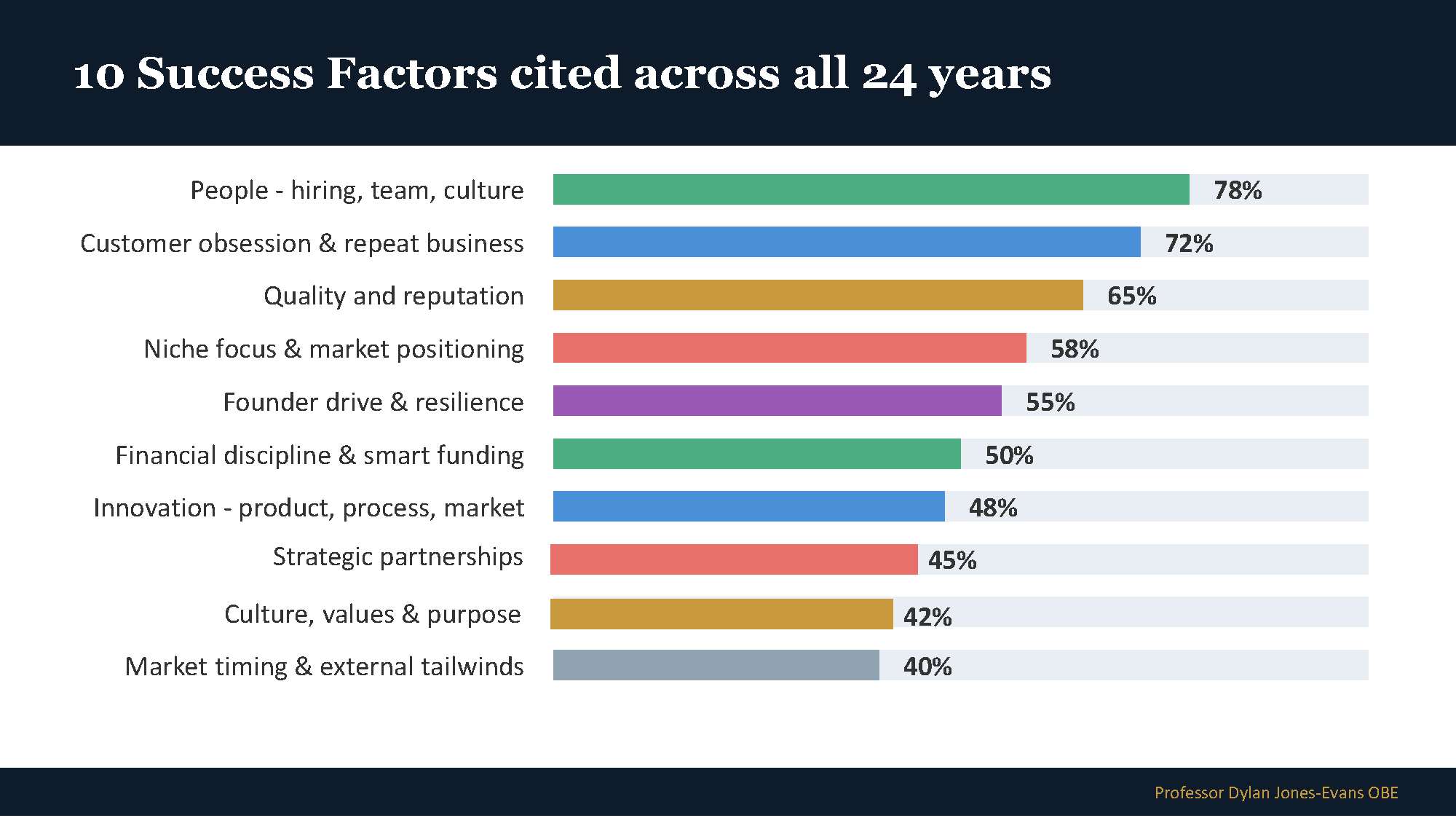
Across 24 years and around 1,200 companies, the analysis identified a consistent set of factors that sit behind sustained growth. While sectors, markets and economic conditions have shifted, the fundamentals have remained remarkably stable.
Here’s what stood out from his study.
People come first
Across every year and every sector, people are the single most consistent driver of growth. They are referenced as a factor of growth in 78% of high-growth businesses.
The way founders talk about this has evolved, from experienced management teams to today’s focus on culture, wellbeing and autonomy. What has not changed is the importance of hiring well and backing your team over time.
The strongest businesses continue to invest in people even when conditions tighten. Those that do tend to outperform those that pull back.
Growth is built on existing customers
One of the clearest patterns in the data is the role of repeat business.
Customer focus appears in 72% of cases, and many of the fastest-growing businesses rely heavily on retention rather than constant acquisition. In some sectors, repeat business accounts for the majority of growth.
Long-term relationships, consistency of service and strong delivery create a base that compounds over time.
Quality and focus drive momentum
A clear link emerges between quality, reputation and specialisation.
Businesses that prioritise standards build credibility. Over time, that credibility turns into referrals, introductions and repeat work. In service-led industries in particular, this becomes a primary route to growth.
At the same time, the most specialised businesses tend to perform best. A clear niche creates differentiation, makes it harder for competitors to compete directly and allows businesses to command stronger pricing.
The challenge is resisting the temptation to broaden too early.
Founder mindset still matters
In over half of the businesses studied, founder drive and resilience are central to growth.
Across different periods, this shows up as persistence, belief and a willingness to keep moving forward when progress is not immediate. These qualities often sit behind the decisions that shape long-term success.
Structure and strategy are important, but founder mindset still plays a defining role.
Cash discipline underpins everything
Despite the focus often placed on fundraising, the study consistently highlights the importance of managing cash well.
Cash flow discipline is cited more frequently than external investment. Many high-growth businesses prioritise reinvestment and grow at a pace they can sustain.
When funding is introduced, it tends to work best when timed carefully rather than used as a default growth lever.
Timing and innovation support scale
Innovation plays an important role, particularly in more recent years, but execution is the distinguishing factor.
Alongside this is timing. External factors such as regulatory changes, technology shifts and wider economic cycles can accelerate growth, but only for businesses that are ready to respond.
Positioning at the right moment often separates steady growth from rapid expansion.
Pressure creates opportunity
Periods of economic pressure reveal clear differences in approach.
During both the financial crisis and the pandemic, businesses that continued to invest in people and maintain market presence emerged in a stronger position. Others slowed or contracted.
Consistent decision-making during uncertainty remains relevant in long-term growth stories.
After 24 years
Looking across more than two decades of data, the conclusion is straightforward.
Fast growth is rarely accidental. It tends to follow a consistent set of principles:
- Invest in people
- Strengthen client relationships
- Stay focused on what you do best
- Manage cash carefully
- Remain flexible enough to respond to change
For founders, the challenge is not understanding these factors, but applying them consistently, particularly when conditions are less certain.