
Archive for the ‘Uncategorized’ Category

When Old Leases Meet Modern Retail

Posted on: June 25th, 2026 by Alanah Lenten

A High Court dispute between John Lewis and the landlords of Brent Cross has put a fundamental question under the spotlight: when retail evolves, do legacy leases evolve with it?

At the centre of the case is whether click-and-collect sales should count towards turnover rent, a model where tenants pay a base rent plus a percentage of store-generated revenue.

It might sound technical. In practice, it goes to the heart of how modern, omnichannel businesses operate.

The background: a lease from another era

The dispute stems from a 1979 lease, agreed decades before online shopping existed.

Under that lease, John Lewis pays a base rent plus a percentage of “gross receipts” once turnover passes certain thresholds. The definition of those receipts includes orders “received or filled at or from the premises”, language originally designed to capture mail and telephone sales.

Today, that wording is being stress-tested against click-and-collect.

The landlords argue that online orders collected in-store, fulfilled from the store, or even initiated in-store should be captured as turnover. John Lewis takes the opposite view: that the sale happens when goods leave the distribution centre, meaning the store is simply a collection point.

Same clause. Very different commercial consequences.

Why this matters

This is more than a rent dispute. It reflects a broader tension between legacy contracts and modern business models.

Retail is no longer neatly split between “in-store” and “online”. For many businesses, the customer journey spans both, browsing online, purchasing digitally, collecting in person.

The problem is that many leases were never drafted with that reality in mind. As this case shows, even seemingly clear wording can become ambiguous when applied to new channels.

So what does this mean in practice for businesses?

  1. Old drafting creates modern risk
    Leases that pre-date e-commerce often rely on broad wording intended to capture indirect sales. That same wording may now be argued to include click-and-collect or other omnichannel activity, depending on how it’s interpreted.
  2. Data is now part of the deal
    Turnover rent only works if sales can be tracked and attributed clearly. In an omnichannel model, that means distinguishing between online, in-store, fulfilled-from-store and fulfilment-centre transactions. Without that clarity, disputes become almost inevitable.
  3. Commercial positions are diverging
    Landlords are increasingly focused on capturing value linked to physical space, particularly where stores play a role in fulfilment or customer experience. Tenants, meanwhile, are focused on ringfencing digital revenue and avoiding double counting.

This case is a reminder that leases are not static documents. Where turnover rent is in play, both sides are now expected to grapple explicitly with omnichannel trading, from click-and-collect to delivery, returns and fulfilment.

Because in modern retail, where a sale is made is no longer obvious. And if it isn’t clear in the lease, it will be argued later.

For more details of this case see our article here.
 

Keeping It in the Family: How FICs Are Reshaping Long-Term Wealth Strategy

Posted on: June 25th, 2026 by Alanah Lenten

For many founders, building a business is only part of the story. The bigger question is what comes next: how to preserve, grow, and pass on that value without losing control along the way.

Family Investment Companies (FICs) are increasingly becoming part of that conversation. Once viewed as niche, they are now firmly on the radar for founders and owner-managed businesses thinking strategically about succession, tax efficiency, and long-term family governance.

What is a FIC, and why are founders using them?

At its core, a Family Investment Company is a private company set up to hold and manage family wealth. Unlike a trust, it gives founders the ability to retain control while gradually transferring value to the next generation.

What makes FICs particularly attractive is this balance: control stays firmly with the founder, while beneficial ownership and future growth can be shared more widely within the family.

For founders used to running their own businesses, that familiarity matters. A FIC operates within a corporate structure, meaning decision-making, governance and oversight can be retained and clearly defined.

A flexible route to succession

Succession is rarely a single moment. It is a process, often evolving over years.

FICs support that phased approach. Founders can introduce children or grandchildren as shareholders early, often through gifting shares or subscribing for new ones, enabling wealth to pass over time rather than all at once.

This creates space for future planning, while also offering potential inheritance tax advantages where transfers qualify under the relevant rules.

Crucially, it allows founders to stay in the driving seat. Voting rights and board control can remain with the founding generation, ensuring continuity in decision-making even as ownership evolves.

Control, but with structure

One of the defining features of a FIC is the ability to tailor how control and value are held.

Different share classes (often referred to as ‘alphabet shares’) can be used to direct income where it’s most efficient, aligning distributions with each family member’s circumstances.

At the same time, rights to capital can be structured so that future growth accrues to the next generation, while founders effectively ‘freeze’ the current value in their own shares.

This isn’t just about tax efficiency. It’s about creating a framework that reflects how families actually want to manage wealth across generations.

More than tax: building long-term governance

Well-structured FICs go beyond financial planning. They can act as a platform for family governance.

Provisions can be built in to protect the integrity of family wealth, for example by restricting who can hold shares or requiring transfers in certain circumstances such as divorce or insolvency.

In practice, this can help mitigate some of the risks founders worry about most, particularly as wealth passes to future generations.

Many FICs also introduce a level of discipline and oversight that mirrors a family office model. Board structures, shareholder agreements and decision-making frameworks help align family members around shared objectives, values and long-term strategy.

Where FICs work best (and where they don’t)

FICs are typically used to hold trading businesses, investment portfolios, property, or to support wider family-owned ventures.

They are less suitable for holding personal-use assets such as holiday homes, or for arrangements involving shareholder loans, where tax implications can quickly become complex.

As with any structure, suitability depends on the wider picture: business interests, family dynamics, risk appetite, and long-term goals.

A strategic tool for founder-led futures

For founder-led businesses, the appeal of a FIC is clear. It reflects a mindset they already understand: control, structure, and strategic planning.

But more importantly, it offers a way to think beyond the immediate exit or liquidity event. Instead, it supports a longer-term view, where wealth is not just transferred, but managed, protected, and grown across generations.

As more founders begin to ask what legacy looks like in practice, FICs are likely to remain firmly on the agenda.

What Actually Drives Fast Growth? Findings from a 24-year Study

Posted on: June 25th, 2026 by Alanah Lenten

At the UK Fast Growth Summit, Professor Dylan Jones-Evans OBE shared with us his insights from the longest-running study of high-growth businesses in the UK.

Across 24 years and around 1,200 companies, the analysis identified a consistent set of factors that sit behind sustained growth. While sectors, markets and economic conditions have shifted, the fundamentals have remained remarkably stable.

Here’s what stood out from his study.

People come first

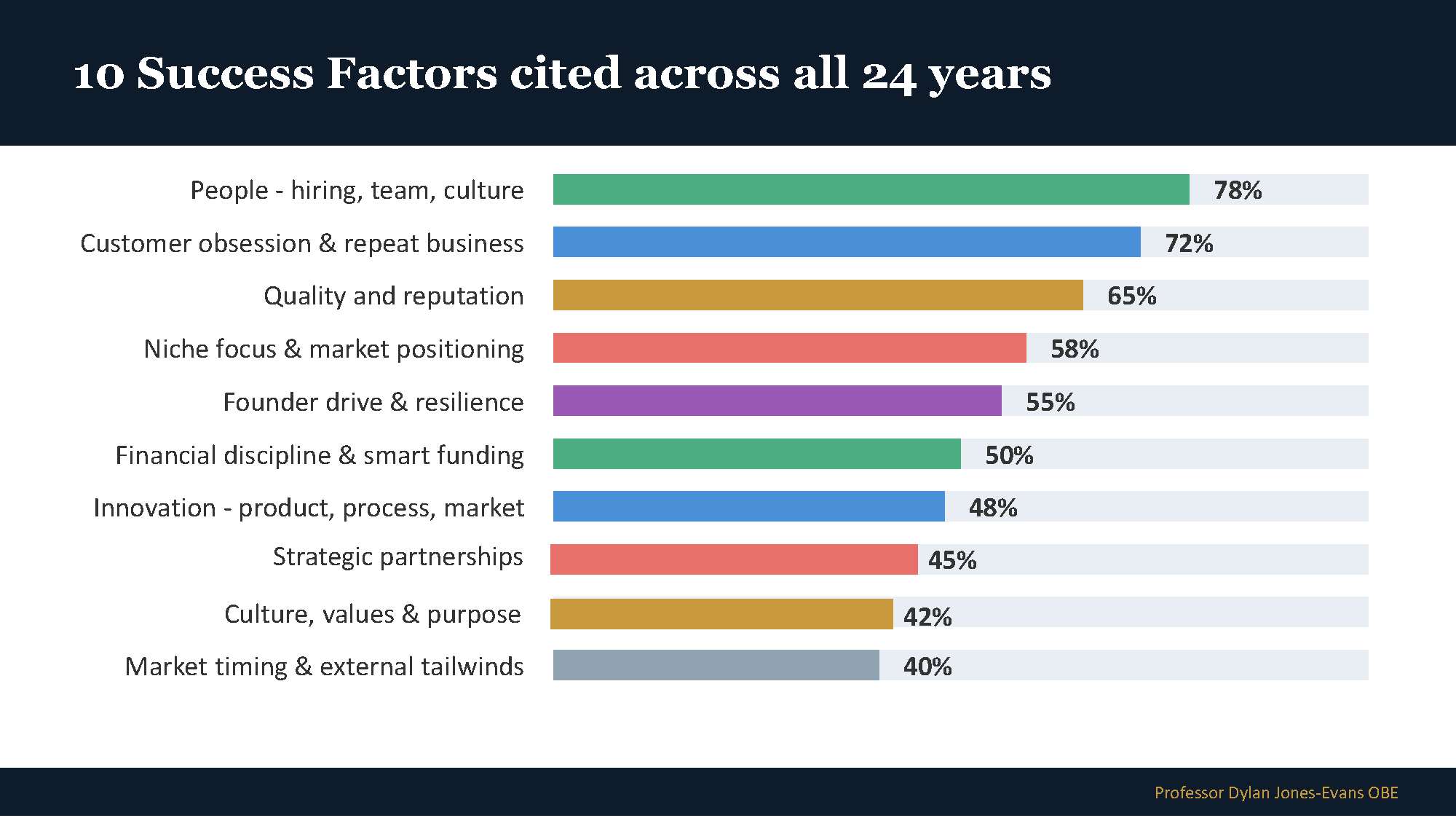
Across every year and every sector, people are the single most consistent driver of growth. They are referenced as a factor of growth in 78% of high-growth businesses.

The way founders talk about this has evolved, from experienced management teams to today’s focus on culture, wellbeing and autonomy. What has not changed is the importance of hiring well and backing your team over time.

The strongest businesses continue to invest in people even when conditions tighten. Those that do tend to outperform those that pull back.

Growth is built on existing customers

One of the clearest patterns in the data is the role of repeat business.

Customer focus appears in 72% of cases, and many of the fastest-growing businesses rely heavily on retention rather than constant acquisition. In some sectors, repeat business accounts for the majority of growth.

Long-term relationships, consistency of service and strong delivery create a base that compounds over time.

Quality and focus drive momentum

A clear link emerges between quality, reputation and specialisation.

Businesses that prioritise standards build credibility. Over time, that credibility turns into referrals, introductions and repeat work. In service-led industries in particular, this becomes a primary route to growth.

At the same time, the most specialised businesses tend to perform best. A clear niche creates differentiation, makes it harder for competitors to compete directly and allows businesses to command stronger pricing.

The challenge is resisting the temptation to broaden too early.

Founder mindset still matters

In over half of the businesses studied, founder drive and resilience are central to growth.

Across different periods, this shows up as persistence, belief and a willingness to keep moving forward when progress is not immediate. These qualities often sit behind the decisions that shape long-term success.

Structure and strategy are important, but founder mindset still plays a defining role.

Cash discipline underpins everything

Despite the focus often placed on fundraising, the study consistently highlights the importance of managing cash well.

Cash flow discipline is cited more frequently than external investment. Many high-growth businesses prioritise reinvestment and grow at a pace they can sustain.

When funding is introduced, it tends to work best when timed carefully rather than used as a default growth lever.

Timing and innovation support scale

Innovation plays an important role, particularly in more recent years, but execution is the distinguishing factor.

Alongside this is timing. External factors such as regulatory changes, technology shifts and wider economic cycles can accelerate growth, but only for businesses that are ready to respond.

Positioning at the right moment often separates steady growth from rapid expansion.

Pressure creates opportunity

Periods of economic pressure reveal clear differences in approach.

During both the financial crisis and the pandemic, businesses that continued to invest in people and maintain market presence emerged in a stronger position. Others slowed or contracted.

Consistent decision-making during uncertainty remains relevant in long-term growth stories.

After 24 years

Looking across more than two decades of data, the conclusion is straightforward.

Fast growth is rarely accidental. It tends to follow a consistent set of principles:

  • Invest in people
  • Strengthen client relationships
  • Stay focused on what you do best
  • Manage cash carefully
  • Remain flexible enough to respond to change

For founders, the challenge is not understanding these factors, but applying them consistently, particularly when conditions are less certain.

Graph to show percentage of cited factors

Doing Business for Good: Lessons from Joe Roberts-Walker, Founder of Mejuicer

Posted on: June 25th, 2026 by Alanah Lenten

We recently welcomed Joe Roberts-Walker, sustainability champion and founder of Mejuicer, to speak candidly about how he has built a purpose-driven business from the ground up and the lessons he learned along the way.

Mejuicer is an award-winning cold pressed juice company built around conscious consumption, health and wellbeing, and giving back. Launched during the 2021 lockdown with just £5,000 in savings and production in his family kitchen, Joe has grown Mejuicer into a fast-scaling business which is now stocked by an impressive client lineup, including Google, ASOS, and Amazon to name a few.

Joe’s journey offers an insightful and practical look at what it takes to build and scale a business that keeps its values at the core of its growth. In this article, we unpack the key insights that early-stage founders can learn from to position your own business for growth.

The Power of People

Looking back on building Mejuicer from his family kitchen, Joe repeatedly returned to one simple but powerful idea: people are your most valuable resource.

  • Invest in relationships early.
    In the early days, networking was key. But what made those connections stick was Joe’s approach to contribute first, rather than just taking from a network. That approach to early goodwill built long term support systems for Mejuicer.
  • See competition as collaborators.
    Rather than seeing competition as purely adversarial, learning from and collaborating with others in the space helped Joe identify opportunities to improve and grow. Particularly in the niche and emerging market of cold-pressed juices, it helped expand Mejuicer’s product awareness and strengthen the market for all parties.
  • The commercial value of community.
    Trust built and strong word-of-mouth endorsement amongst Joe’s community meant that Mejuicer has actually spent almost nothing on advertising through the years. In Joe’s case, strong relationships were just as powerful as a marketing budget.

Embracing mistakes as an opportunity for growth

One of Joe’s key reflections was how an early mistake ended up reshaping the entire business model of Mejuicer. For Joe, some of the biggest steps forward came from getting it wrong first and being open to mistakes, so long as you know how to adapt from them.

  • Act fast, learn faster.
    Joe initially centred Mejuicer’s products around carrot-based juices, only to discover this had a shelf life of just two days. In contrast, ginger-based juices lasted up to seven, which prompted a quick pivot in product which is now what Mejuicer is known and loved for by consumers today.
  • Treat mistakes as data, not failure.
    Taking risks, being open to making mistakes and ultimately “just doing it” revealed insights Joe couldn’t have found through planning alone.
  • Cover the fundamentals, even if you’re learning on the job.
    Joe highlighted the importance of understanding every core area of the business early on, from operations and finance to brand and compliance. It’s okay to not be an expert in each, but leaving gaps at the outset can create risk before you’re ready to bring in support and grow your team to cover these areas.

Evolving pressure: how responsibility shifts with growth

One very real aspect Joe spoke about was how the pressure of building Mejuicer didn’t disappear as the business grew, it adapted. Personal risk quickly became responsibility for others, and this reshaped how he approached decisions and growth.

  • Pressure grows with your team.
    Early on, the stakes were personal and if things went wrong, it meant getting by. If it was beans on toast for dinner every night, joe could learn to live with it. But as Joe’s team grew, the priority shifted to ensuring salaries were paid and that his employees were protected.
  • From survival to stability.
    The focus moved from staying afloat to managing cash flow, consistency and building a business that could sustainably support others.
  • Structure becomes essential.
    Growth brought the need for a more proactive approach to managing financial risk, operational dependencies and team capacity in a way that wasn’t necessary at the start.

Navigating the UK business landscape

Whilst acknowledging the challenges that the UK business environment can present, Joe also challenged this negative perception. His experience shows there is key support available, but founders must choose to engage with it.

  • The support is there, use it.
    From funding initiatives to industry communities, founders have access to networks, organisations and support schemes at every stage of their journey.
  • Don’t build in isolation.
    Engaging with communities early opens up access to advice, partnerships and opportunities that are hard to access alone
  • Mindset matters.
    Joe emphasised that founders who are proactive, resourceful and open to collaboration are well positioned to benefit from what’s available.

In short, opportunities are there for your business, but you should actively engage with them. For a breakdown of the government’s recent UK SME growth strategy, published August 2025, and how your business can benefit from the reforms, see our previous Fineprint article.

Success is multifaceted

Joe concluded by challenging traditional perceptions of success as an entrepreneur, and offered a grounded perspective shaped by his own journey building Mejuicer.

  • Success is more than revenue.
    For Joe, success is freedom, building a strong team, and creating opportunities for others, not just hitting financial milestones. Particularly for a purpose-led business, this also meant staying closely aligned to his sustainability practices and other core values during commercial growth and scaling.
  • Define success on your own terms.
    Joe encouraged other founders to focus on what success genuinely looks like for them. You don’t have to be making millions to be successful right now, and defining success for yourself is often what gets you through the hardest stages.

Continuing the conversation
We’ll be exploring these themes in more depth at Ideas Fest, where Lawrence Stephens will be hosting a panel on Growth for Good, bringing together founders to talk honestly about how to scale a business without losing what matters.

If you’re heading to the field, you can join us there, if you haven’t yet got tickets:

Access our exclusive partner discount here

Building Better Businesses Together: Our Partnership with The Ideas Community

Posted on: June 25th, 2026 by Alanah Lenten

Access your discount for Ideas Fest here

At Lawrence Stephens, we’ve always believed that the best outcomes for founders come from genuine partnership. Not just providing advice when it’s needed, but showing up early, understanding the journey and supporting businesses as they grow.

It’s why we’re proud to partner with The Ideas Community, one of the UK’s most influential founder networks.

The Ideas Community brings together entrepreneurs, business leaders and high-growth companies through events, awards and curated experiences that create space for honest conversation, shared learning and meaningful connection. It’s a community built on the belief that founders grow faster when they learn from each other and are surrounded by the right people.

That belief closely mirrors our own.

A shared approach to supporting founders

As a founder-led law firm, we understand the challenges that come with building and scaling a business. Many of our clients are owner-managed businesses navigating growth, investment and long-term planning, and they need advisers who think commercially, move at pace and feel like part of the team.

This partnership reflects a shared commitment to supporting founders in a more meaningful way.

As Steven Bernstein, CEO and Co-founder at Lawrence Stephens, explains:

“We see our partnership with the Ideas Community as a long term investment in the UK’s entrepreneurial community. As our partnership continues to grow, our focus remains the same: showing up where founders are, contributing value early, and building relationships that last well beyond any single event or milestone.”

Connection, collaboration and practical insight

Through our partnership, we’ll be actively involved across the Ideas Community calendar. From curated dinners and roundtables to larger events and informal meet-ups, our focus is simple: creating opportunities for founders to connect, collaborate and access practical insight.

We’ll also be offering informal conversations and legal clinics, helping founders navigate key moments in their journey, from structuring and governance through to investment and exit. Always practical, always commercially focused.

Kicking things off

We recently launched the partnership at The House of Ideas, an event hosted at The Britannia in Shoreditch. Bringing together a small group of founders and business leaders, the evening was a reflection of what this partnership is all about: honest conversations, strong connections and a room full of ambitious people building exciting businesses.

It was the first of many moments where we’ll be working closely with the community.

Join us at Ideas Fest

One of the highlights of the partnership will be Ideas Fest this September, where Lawrence Stephens will have its own dedicated tent in the centre of the action.

The tent will be a space for founders to drop in, connect with our team, have informal conversations and gain practical insight into the legal challenges that come with growth. Whether you’re navigating investment, scaling your business or planning for the future, we’ll be there to listen, share ideas and support.

If you’re attending Ideas Fest, we’d love to see you there.

And if you’re yet to book your ticket, you can use our exclusive discount page at the top of this article.

Looking ahead

This partnership is just the beginning. Over the coming months, we’ll be woven into the fabric of the Ideas Community, from the Great British Entrepreneur Awards to the UK Fast Growth Index and beyond.

Through each touchpoint, our aim is to get to know the people behind the businesses, understand what they are building and offer meaningful support along the way.

Because building a business is never done in isolation and we’re committed to building better businesses together.

Important ESG Clauses Entering Commercial Leases

Posted on: June 23rd, 2026 by zhewison

Over the last few years, environmental, social and governance (ESG) considerations have moved from being a desirable extra to a core driver in commercial real estate. A building’s ESG performance depends not only on the owner’s investment strategy and asset management, but also on how occupiers use, fit out and operate their premises. For that reason, the lease has become the principal document through which ESG responsibilities are allocated, monitored and, where necessary, enforced.

Why ESG Clauses Matter

Sustainability is now shaped by regulatory pressure, investor expectations, lender requirements and occupier demand for better-performing buildings. In practice, modern lease drafting is increasingly concerned with energy efficiency, environmental performance and the long-term management of assets. Many ESG negotiations are therefore not simply about principle, they are about allocating the cost and responsibility of achieving sustainability targets between landlord and tenant.

Energy and Environmental Data Sharing

One of the most common and important ESG provisions is the obligation to share energy and environmental data. These clauses typically require the parties to provide information about energy usage, utilities consumption, waste management and other environmental performance metrics. They are significant because they provide the foundation for wider ESG monitoring. Without reliable data, landlords and investors cannot set targets, measure progress or identify where improvements are needed across a portfolio. From the tenant’s perspective, however, these obligations can raise concerns about administrative burden, confidentiality and how operational data may ultimately be used. Even so, relatively straightforward reporting obligations can have major practical significance because they support broader compliance and sustainability strategies.

Collaboration and ESG Strategy Clauses

Historically, green lease clauses were often light-touch and one-sided, usually restricting tenant behaviour or reserving rights for landlords to carry out upgrades. Modern drafting is more collaborative. It increasingly requires landlords and tenants to cooperate on sustainability initiatives, act consistently with environmental objectives, and use reasonable endeavours to improve a building’s environmental performance. Although these provisions can be difficult to enforce if they are expressed only in general terms, they are still important because they establish a shared ESG framework within the lease. In that sense, they often act as the starting point on which more specific and measurable obligations are built.

Alterations, ESG Works and Cost Recovery

Another major area of ESG drafting concerns tenant fit-out and alterations. Clauses increasingly restrict works that would reduce an EPC rating, require the use of sustainable materials, limit the installation of energy-intensive equipment, or prevent interference with building systems designed to improve environmental performance. Alongside these restrictions, modern institutional leases often reserve rights for landlords to enter premises and carry out sustainability upgrades aimed at improving energy efficiency or wider environmental performance. These rights are important from an asset management perspective because they enable buildings to be upgraded over time without being wholly dependent on tenant consent. The commercially sensitive issue, however, is often not whether such works should be done, but who should pay for them. Service charge recovery for ESG improvements has therefore become one of the most negotiated parts of modern green leasing. Landlords commonly seek flexibility to recover the cost of energy-efficient upgrades, decarbonisation works and other environmental improvements, while tenants, particularly short-term occupiers, may resist contributing towards expenditure that appears primarily to enhance the long-term value of the landlord’s asset. This tension has led to more nuanced approaches, including payback models under which a landlord recovers the cost of improvements only to the extent that those works generate measurable savings for the tenant over time.

Takeaways

ESG clauses are significant not only because of regulatory developments, but also because they reflect changing expectations about how commercial buildings are owned, managed and occupied. Leases are now central to delivering sustainability in practice. As ESG requirements become more detailed and more closely tied to value, funding and compliance, a clear understanding of these provisions will be essential for landlords, tenants and their advisers alike.

If you are a landlord or tenant and would like advice on ESG clauses in commercial leases, please contact a member of our Commercial Real Estate team.

The Employment Rights Act Timeline

Posted on: June 22nd, 2026 by Alanah Lenten

The Employment Rights Act introduces significant changes to employment law. Employers and HR professionals will need to navigate a complex and evolving landscape over the next two years to ensure compliance. Below is a timeline outlining the key changes we know so far.

December 2025

  • The Employment Rights Bill receives Royal Assent, becoming the Employment Rights Act 2025 (“the ERA”).
  • Immediate effect:
    • Repeal of the Strikes (Minimum Service Levels) Act 2023.
  • No other wide-ranging employment rights take effect at this stage.
  • The period following Royal Assent is characterised as pre‑implementation, with employers expected to prepare rather than change operational practices immediately.

January 2026

  • Employers expected to transition from monitoring legislation to active planning for changes due from February and April 2026.
  • The government commenced a number of consultations which are expected to shape and underpin the new obligations created in the ERA.

February 2026

  • Trade union reforms take effect, including:
    • Repeal of most of the Trade Union Act 2016, simplifying industrial action and ballot notices.
    • Removal of the 12-week limit on protection from dismissal for taking industrial action.

April 2026

  • National Minimum Wage Increase comes into force.
  • Statutory Sick Pay (“SSP”):
    • Lower Earnings Limit and waiting period removed meaning SSP is payable from day-one of employment.
  • Day-one rights introduced:
    • Paternity leave.
    • Unpaid parental leave.
  • Collective redundancy:
    • Maximum protective award doubled from 90-180 days’ pay.
  • Whistleblowing protections extended to include disclosures relating to sexual harassment.
  • Bereaved Partners’ Paternity Leave:
    • Up to 52 weeks’ leave where the mother or primary adopter dies within the first year.
  • Voluntary gender equality and menopause action plans commence.
  • Holiday Pay & Leave Records:
    • Employers now have a legal duty to keep specific, adequate records evidencing compliance with holiday pay and annual leave entitlements, which must be retained for 6 years.
  • The Fair Work Agency is established, consolidating enforcement of several employment rights (with enforcement powers to expand following further commencement).

July 2026

  • Employees hired from late June 2026 onwards will fall within the cohort that gains unfair dismissal protection once the shortened qualifying period takes effect in January 2027.

August 2026:

  • Introduction of electronic and workplace balloting for statutory trade union ballots.

October 2026

  • Extension of Employment Tribunal limitation periods to six months.
  • Expanded duty on employers to take all reasonable preventative steps to protect employees from sexual harassment.
  • New employer responsibility to prevent harassment by third parties, such as clients or customers.
  • New requirement for employers to inform workers of their right to join a trade union.
  • Re‑introduction of procurement rules addressing two‑tier workforce arrangements.
  • Further tightening of the legal framework governing tips and service charges.
  • Strengthening of trade union access rights to workplaces.
  • Regulation aimed at addressing unfair practices in trade union recognition procedures.
  • Introduction of additional rights and safeguards for trade union representatives.
  • Extension of protection against detriment suffered as a result of participating in industrial action.

January 2027

  • Unfair dismissal reforms:
    • Reduction of the qualifying period for unfair dismissal claims to six months’ service.
    • Removal of the statutory cap on compensation for unfair dismissal.
  • Restrictions on dismissal and re‑engagement (“fire and rehire”), significantly limiting employers’ ability to impose contractual changes through dismissal.
  • These changes apply to dismissals occurring on or after 1 January 2027, with employees hired from mid‑2026 falling within scope once they reach six months’ service.

During 2027

  • Workforce terms and flexibility:
    • Guaranteed hours and enhanced shift notice rules for zero‑ and low‑hours workers.
    • New collective redundancy consultation threshold.
    • Further reforms to flexible working requests.
  • Equality, family rights and workplace protections:
    • Mandatory gender equality and menopause action plans.
    • Enhanced dismissal protection for pregnant employees and maternity returners.
    • Statutory bereavement leave, including following pregnancy loss.
    • Strengthened sexual harassment regime, including defined “reasonable steps” for prevention.
  • Trade unions and industrial relations:
    • Strengthened industrial relations framework, including extended blacklisting protections.
    • New rights and safeguards for trade union representatives.
    • Reforms to union recognition and consultation procedures.
    • Introduction of electronic and workplace balloting for recognition and derecognition.
  • Regulation:
    • Regulation of umbrella companies.
    • Tighter rules governing the allocation and treatment of tips.

TBC

  • The ERA also provides for additional restrictions on the use of non‑disclosure agreements (“NDAs”) in an employment context; however, these measures do not appear in the revised implementation timetable and the timing remains uncertain.

If you would like to discuss how the ERA will affect you and your business, please get in touch. 

Lawrence Stephens Supports Howden on Launch of Web3 Risk Ecosystem

Posted on: June 11th, 2026 by Ella Darnell

Howden, the global insurance intermediary group, has announced the launch of a comprehensive Web3 risk ecosystem, evolving its digital asset offering to provide end-to-end support across the full risk lifecycle.

The launch builds on Howden’s earlier collaboration with Lawrence Stephens on its crypto theft insurance and recovery solution, first introduced in 2025, and reflects growing client demand for integrated support spanning prevention, operational resilience, incident response and asset recovery.

The enhanced ecosystem brings together a curated network of specialist providers across key areas of the digital asset landscape, including security infrastructure, forensic investigation, restructuring, asset tracing and legal advisory. Lawrence Stephens forms part of this panel, working alongside leading global vendors to deliver coordinated recovery and legal support in the event of digital asset loss.

As part of the ecosystem, Lawrence Stephens provides integrated legal and recovery capabilities, including the coordination of blockchain forensic analysis, asset tracing strategies, and engagement with exchanges and other relevant stakeholders. This enables swift and effective action to trace, freeze and recover stolen digital assets, supporting clients through complex, often cross-border recovery scenarios.

The expanded model represents a shift from traditional, reactive insurance solutions to a more holistic approach, embedding pre-emptive expertise alongside claims and recovery services. By combining legal, technical and operational capabilities, the ecosystem is designed to help clients strengthen resilience before an incident occurs, while improving recovery outcomes where losses arise.

Matt Green, Head of Blockchain, Digital Assets and Technology Disputes at Lawrence Stephens, commented: “We are delighted to continue working alongside Howden, who recognise the importance of having a panel of leading specialists to support clients in this space. Effective recovery requires a combination of expertise, including blockchain forensic analysis, OSINT, and active engagement with exchanges and other stakeholders to trace, freeze or seize stolen assets.”

This latest development reinforces Lawrence Stephens position at the forefront of digital asset disputes and recovery, and highlights the firm’s ongoing role in supporting innovative, market-leading solutions for clients operating in the Web3 and blockchain space.

Lawrence Stephens and Fidelius launch joint venture, LS Wealth

Posted on: June 2nd, 2026 by Alanah Lenten

Fidelius, the Bath-based advisory firm, and Lawrence Stephens, the London-based law firm, today announce a new joint venture, LS Wealth.  This new venture will combine Lawrence Stephens full-service legal expertise with Fidelius’s fast-growing, objective-based financial planning business to create a fully integrated experience for clients.

The new venture, LS Wealth, is a trading style of Fidelius. With a seamless client experience at its heart, the joint venture will see strong collaboration between the two brands, expanding the proposition for both firms and increasing opportunities to generate leads and referrals.

Steve Skelding, Head of Commercial at Fidelius, said: “We are excited to have the opportunity to work closely with the skilled professionals at Lawrence Stephens as we launch our new venture, LS Wealth. There is a close cultural fit between our two businesses, rooted in exceptional client service. Our brands also feel aligned in terms of our commercial approach, so we look forward to seeing what we can achieve as we join forces in this way.”

Steven Bernstein, Chief Executive Officer at Lawrence Stephens, added: “We’re delighted to team-up with Fidelius. We believe that a joined-up approach from professional advisers can provide the optimum outcome for our clients. Fidelius’ clients often engage with them at some of the most critical stages in their personal or business journey. It’s no surprise then to find that they are often seeking legal advice at the same time as reviewing their wealth management options. We have enjoyed a longstanding relationship with their like-minded team who share our values, ambition and commitment and we look forward to working with them in this exciting new venture”

Lawrence Stephens Advises on the Sale of Agility Fleet to Driveway Vehicle Solutions

Posted on: May 18th, 2026 by Ella Darnell

Lawrence Stephens is pleased to have advised the shareholders of Agility Fleet Holdings and its subsidiary companies on the successful sale of Agility Fleet Holdings to Driveway Vehicle Solutions, part of Lithia UK.

Agility Fleet, a Bromsgrove based fleet management, contract hire and leasing business, has built a strong reputation for delivering responsive and customer focused services over more than two decades. The transaction sees Driveway Vehicle Solutions acquire Agility Fleet’s managed vehicle portfolio, FCA registration and operational expertise, adding more than 1,200 vehicles to its fleet and strengthening its position as a leading UK provider.

Lawrence Stephens advised the shareholders of Agility Fleet, throughout the transaction, supporting them through the sale process and helping to deliver a smooth and successful outcome.

Commenting on the transaction, Jeff Rubenstein, Head of Corporate and Commercial at Lawrence Stephens, said:

“This transaction represents a fantastic outcome for the Agility Fleet shareholders following many years of dedication to building a high quality, customer focused business. It has been a pleasure to support them through this important milestone and to help secure a future for the business with Driveway Vehicle Solutions, which is well positioned to drive the next phase of growth. This deal reflects the continued strength of the market for well run, service led businesses and the strategic appetite for acquisitions that deliver immediate scale and capability.”

Keith Townsend, Chairman of Agility Fleet, added:

“Lawrence Stephens provided invaluable support throughout the transaction, guiding us carefully through each stage of the process. Their pragmatic advice and deep understanding of our objectives helped ensure a smooth and successful outcome. We are incredibly grateful for their support as we complete this important chapter for the business and move into its next phase with Driveway Vehicle Solutions.”

Driveway Vehicle Solutions, which has experienced strong growth over the past year, continues to pursue an ambitious strategy to expand its fleet and capabilities, with a focus on delivering enhanced choice, service and value to customers. The acquisition of Agility Fleet marks a further step in that journey.

The Lawrence Stephens team was led by Jeff Rubenstein, supported by Harshita Samani, Avni Patel and Sophia Dixon.

This transaction reflects Lawrence Stephens’ continued strength in advising founders, owner managed businesses and shareholders on strategic exits, particularly where businesses are transitioning into larger platforms positioned for further growth.


Lawrence Stephens Advises Videx Electronics on UK Acquisition

Posted on: May 11th, 2026 by Ella Darnell

Lawrence Stephens is pleased to have advised Videx Electronics S.p.A., a leading Italian manufacturer of advanced intercom and video intercom systems, on the acquisition of its sole and exclusive UK distributor.

The transaction represents a significant milestone for Videx, strengthening its direct presence in the UK market and supporting the continued expansion of its international operations.

Lawrence Stephens acted on the UK legal aspects of the transaction, working closely with Videx and its advisers across jurisdictions to deliver a seamless cross border deal.

The matter was led by Jeff Rubenstein, supported by Harshita Samani, Krysha Hunt, Emma Cocker, Isobel Moran and Avni Patel, drawing on the firm’s experience in cross border M&A and international corporate transactions.

Jeff Rubenstein commented:

“We were delighted to support Videx on this strategically important acquisition. Bringing the UK distribution business in house is a clear statement of Videx’s long term commitment to the UK market, and it was a pleasure to work alongside such a collaborative and well aligned group of advisers to achieve a successful outcome.”

Edoardo Marcantoni, Executive Manager of Videx.it, added:

“This acquisition marks an important step in strengthening our presence in the UK and further developing our international footprint. We greatly appreciated the clear, commercial and responsive support from the Lawrence Stephens team, who worked closely and seamlessly with our advisers in Italy and the UK to guide us through the UK legal aspects of the transaction.”

A number of advisers supported the transaction across jurisdictions, including:

  • M&A Financial Advisory (valuation, acquisition finance and financial due diligence):

Bernoni Grant Thornton (Italy) – Sante Maiolica and Giovanni Marino

  • UK Tax Advisory (including tax due diligence):

Grant Thornton UK – James Moore

  • Italian Legal Advisory:

Lexalia Law Firm – Domenico Mastrangelo and Andrea Lino

Lawrence Stephens would like to thank Videx and all advisers involved for their collaboration and commitment in delivering this successful cross border transaction.

Lawrence Stephens Announces Partnership with Ideas Community

Posted on: May 7th, 2026 by Alanah Lenten

Lawrence Stephens is proud to partner with the Ideas Community, one of the UK’s most influential founder networks, connecting entrepreneurs, business leaders and high-growth companies.

Through events, awards and curated experiences, the Ideas Community creates spaces where founders share ideas, tackle challenges openly and build relationships that drive their businesses forward. This partnership reflects a shared belief: founders benefit most from advisers who understand what they are building and show up as true partners.

As Steven Bernstein, CEO and Founder at Lawrence Stephens explains:

“We see our partnership with the Ideas Community as a long‑term investment in the UK’s entrepreneurial community. As our partnership continues to grow, our focus remains the same: showing up where founders are, contributing value early, and building relationships that last well beyond any single event or milestone.”

Francesca James, Founder of Ideas Community adds:

“We set out to find a legal partner who matches the ambition and pace of our community. Lawrence Stephens doesn’t just act for founders, they think like them and that’s why we’re proud to have them alongside us.”

Supporting founders in practice

Lawrence Stephens will play an active role across the Ideas Community, from roundtables and events to informal legal clinics and founder discussions. The focus is on practical, commercially-minded support, from structuring and governance through to investment, exits and long-term planning.

This approach reflects how the firm works more broadly: building relationships early and supporting clients as they grow.

A shared commitment to growth

The firm supports businesses at every stage, including early-stage ventures through our Flourish programme, which offers tailored legal support for start-ups. We also share practical insight through The Fineprint, our newsletter focused on the realities of building and scaling a business. Lawrence Stephens’ commitment to the SME market is further recognised by its Band 1 ranking in the Chambers UK 2026 SME-focused Firms category.

The partnership officially launched at “The House of Ideas,” an Ideas Community event held at The Britannia in Shoreditch, where a select group of founders and business leaders came together for an evening of conversation, connection and collaboration.

It marked the first of many moments where Lawrence Stephens will be present across the Ideas Community calendar,  from curated dinners and roundtables to major events including the Great British Entrepreneur Awards, the UK Fast Growth Index and Ideas Fest.

Through each of these touchpoints, the aim is simple: to get to know the people behind the businesses, understand what they are building, and offer meaningful, practical support along the way.

As the partnership develops, Lawrence Stephens looks forward to playing an active role in the community,  helping founders navigate the complexities of growth while building relationships that endure.

Learn more about how we help owner-managed businesses and founders here.